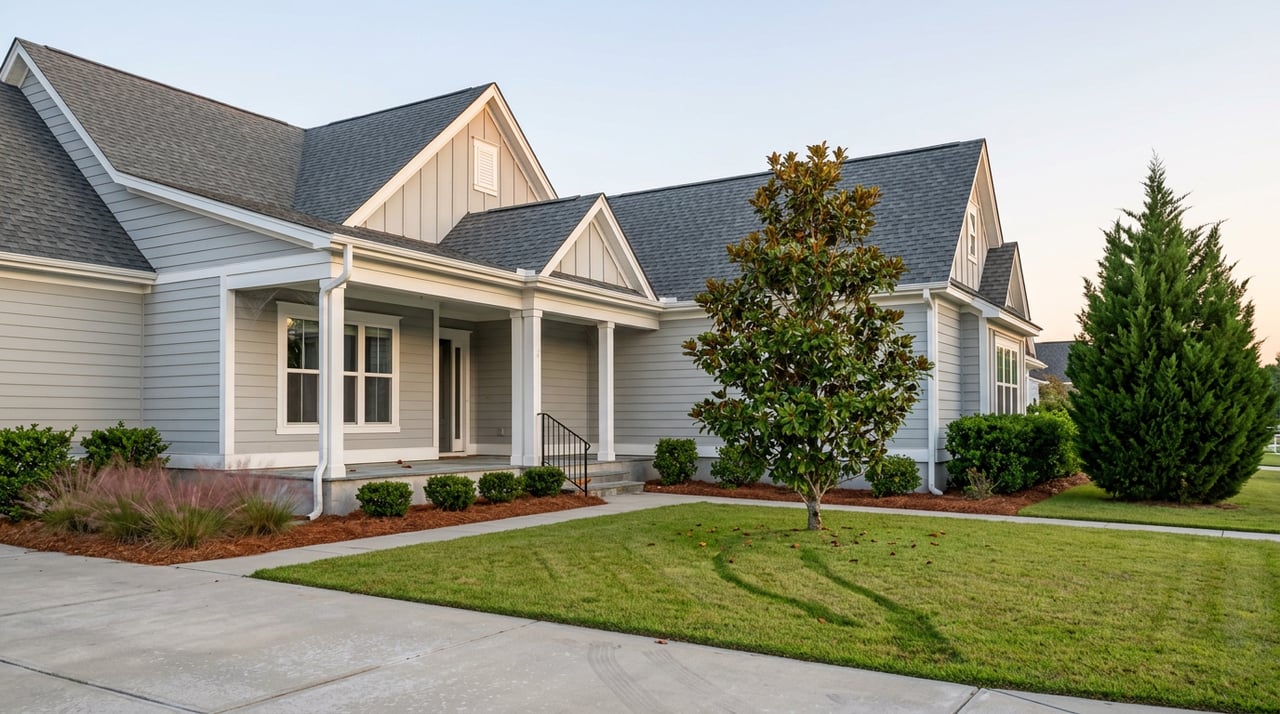
On September 17, 2026, a three-bedroom home at Woodfield Preserve in Milton closed for $499,990. It had been on the market for a matter of weeks. A few miles away, on the same week, a comparable resale listing was heading into its third month with no offer.
That gap is not a coincidence, and it is not really about buyer hesitation. It is about where the buyers actually went.
The Math That Doesn't Add Up on Paper
Look at Milton's numbers from two angles and they tell contradictory stories. Over the three months ending in May 2026, homes that actually sold in Milton closed at a median price of $435,000, down 4.5 percent from the same period a year earlier. Homes that sold this spring took an average of 90 days to get there, up from 55 days the year before. That is a real slowdown in closing speed, even as prices softened.
Now look at what is listed today. As of August 2026, active resale listings in Milton carried a median asking price of $549,000, up 2 percent year over year, sitting on the market for a median of 125 days. Sellers are asking more. Buyers are closing for less. The distance between those two numbers, roughly $110,000, is the space where deals stall.
If you only read the asking-price data, Milton looks like a seller's market holding steady. If you only read the closed-sale data, it looks like a market correcting. Both are true at once, and the reason is that a meaningful share of resale sellers are still pricing against last year's comps while the buyer pool comparing their home has other, cheaper options a short drive away.
Where the Missing Buyers Went
Redfin's new-construction listings for Milton currently show 71 active new homes at a median listing price of $475,000, a price point that sits comfortably between the town's median closed sale and its median resale ask. That is not a coincidence either. Builders are pricing spec homes to move, and buyers who might otherwise negotiate hard on an older resale listing are choosing a new build instead.
The communities doing this are not hypothetical. Schell Brothers is building at Miralon, where pond-front homesites come with designer upgrades already included and, in at least one recent listing, a former model home with all the decorator furnishings conveying. D.R. Horton is active at The Granary at Draper Farm, offering eight floor plans from 1,437 to 2,814 square feet built around wellness and sustainability themes, and at Woodfield Preserve, where that September closing happened. Capstone Homes is building custom lots at the Estates at Milton Crossing. Ryan Homes lists 19 separate communities in and around Milton. Lightship Cove, tucked off Fisher Road, is adding a pool, a tot lot, and pickleball courts to go with its homesites. Quail Run Estates is marketing half-acre lots with low HOA fees, and Martins Farm is offering five wooded homesites with no HOA at all.
Every one of those communities is a buyer's alternative to the resale listing down the street. And every one of them comes with something a resale seller cannot easily match.
What a Builder Can Offer That a Resale Listing Can't
A resale seller's only real lever is price. A builder has a longer menu. New construction routinely comes bundled with mortgage rate buydowns, design center credits toward finishes and upgrades, and a builder's warranty on the structure and systems, all of which can make a $475,000 new build feel like better value than a $549,000 resale home even before either side negotiates.
That is the mechanism behind Milton's stretched days-on-market. It is not that buyers disappeared. It is that a chunk of the buyer pool that would have toured a resale listing toured a model home instead, and the builder made staying easier than leaving. A resale seller who prices to last year's market is not just waiting for a buyer. They are waiting for a buyer who has already ruled out Miralon, Woodfield Preserve, or The Granary at Draper Farm on price or incentives, and there are fewer of those buyers than there used to be.
What This Means If You're Selling in Milton Right Now
If your home has been listed for two or three months without an offer, the honest question is not whether your house is good enough. It is whether your asking price is competing against the wrong comp set. A resale listing priced against last year's $549,000 median is effectively being cross-shopped against new construction at $475,000 with a rate buydown attached, not against other resale homes from a year ago.
That does not mean underpricing your home. It means pricing it against what is actually available to a buyer this month, new and resale both, and being ready to talk through what a buyer gets for the difference: an established lot, mature landscaping, proximity to Milton's downtown and its 198 historic structures, or systems and finishes that a builder's incentive package cannot fully replicate. Those are real advantages. They just have to be priced and marketed as advantages, not assumed.
What This Means If You're Buying
If you are comparing a resale home in Milton against a new build, the comparison is rarely a straight price-per-square-foot exercise. A $475,000 new construction listing with a builder-paid rate buydown can carry a lower effective monthly payment than a $435,000 resale home financed at a market rate, even though the sticker prices suggest the opposite. At the same time, a resale home in an established neighborhood may come with a mature lot, no HOA ramp-up assessments, and closer proximity to Milton's historic downtown, something a homesite in a newer community further out may not offer for several more years of buildout.
The honest way to compare them is to put the total cost, not just the list price, side by side: purchase price, financing terms, HOA dues (Quail Run Estates advertises low fees, Martins Farm has none, other communities vary), and what upgrades are truly included versus what will cost extra at the design center. A buyer who does that math before writing an offer is in a much stronger position than one comparing two numbers on a listing sheet.
A Few Questions Worth Asking Before You List or Offer
Is Milton currently a buyer's or a seller's market? The honest answer is that it depends which data you trust. Closed sales point toward a market that has softened on price. Active listings point toward sellers still asking for last year's numbers. The practical answer for anyone transacting now is that leverage sits with buyers who are willing to walk, because they have real new-construction alternatives at competitive price points.
Should I price my resale home to compete with new construction incentives? Not necessarily dollar for dollar, since your home likely has advantages a spec home does not. But you should know what the builder incentive is worth in monthly payment terms before you set your list price, so your number reflects an accurate comparison rather than last year's market.
Are builder incentives always better than a straight price cut on a resale home? Not always. A rate buydown helps most in the first few years of a loan and its value depends on how long a buyer plans to keep that rate. Running the actual numbers on your specific financing situation matters more than assuming one path is automatically cheaper.
Milton's market right now rewards buyers and sellers who look past the headline number, whether that number is a builder's incentive or a resale asking price. If you are trying to figure out where your home or your budget actually lands in that comparison, The Delashore Team has been tracking builder pricing and resale trends across Sussex County long enough to walk you through it property by property. Request a Free Home Valuation and let's look at your specific numbers before you list or make an offer.